Ulcinj 2026: Old Town, Living Culture and Southern Coast
Read Ulcinj through verified layers: a protected but not inscribed Old Town, Albanian-speaking civic life, corsair history, sand coast, salina and practical trip choices.
360 mof beach
74 kmto the airport
€15a sunbed
Jul–Augthe busy months
From the ArchivesUpdated Originally published 52 min readby Alex Obradovic
Ulcinj (Ulqin) is not simply Montenegro’s last coastal town before Albania. It is a municipality where Albanian is the majority mother tongue, a fortified headland built through Mediterranean empires, a sand coast divided among many managed bathing sectors, and a wetland whose international value depends on water management rather than postcard beauty. Set on a rocky promontory just above the Albanian border, where the Adriatic meets the long sandy delta of the Bojana River, it is also the country’s most distinctive seaside destination: a clifftop Old Town with more than two thousand years of history, the longest sandy beach in Montenegro, a triangular river island famous for its naturist village and stilt fish restaurants, and a salt-pan reserve where flamingos gather in their hundreds. The town makes most sense when these layers are read together.
Ulcinj works best when you stop treating it as one beach plus one Old Town. Its strongest landmark is the Old Town, nationally protected since 1961 and on UNESCO’s Tentative List since 2018. That wording matters: Ulcinj is not an inscribed World Heritage property. Beyond the walls the distances are real — Ada Bojana is a thirty-seven-minute drive for a place you can see from the end of the beach, and the Salina gate is twelve minutes the other way. A useful visit is therefore a sequence, not one attraction, and a useful 2026 plan chooses one compact city experience and one wider-coast experience, with exact water, access and operating checks for each.
This guide covers what there is to see, the beaches, kitesurfing, birdwatching, where to stay and eat, how to get there, the best time to come and the easiest day trips — and it shows how to select a beach sector, read Old Town evidence, avoid medical and Cervantes myths, and build a one- or two-day visit without assuming every attraction is open or every photograph describes present conditions.
READ THE STATUS PRECISELY — Ulcinj Old Town heritage status
Status
Detail
Note
PROTECTED
national cultural asset
since 1961
TENTATIVE LIST
submitted 2018
State Party dossier
NOT INSCRIBED
not World Heritage
not a UNESCO listing
Source: whc.unesco.org
Why visit Ulcinj
Ulcinj rewards travellers who want sand rather than pebbles, heritage rather than resorts, and a little more edge than the polished bays further north. The tourism organisation counts about 20 km of beach in the municipality, 15 km of it fine sand, and it runs from a 360 m crescent under the Old Town walls — room for about 2,500 sunbathers, which in August is not enough — to the 12 km of Velika Plaža (“Long Beach”) heading south towards Albania, with olive-shaded shingle, a women-only cove and a river island in between. Above them, the fortified Old Town sits on a rock over the sea, a candidate on the UNESCO World Heritage Tentative List. Add the river island of Ada Bojana, the Ulcinj Salina salt pans, a kitesurfing scene that draws riders from across Europe, and a food culture shaped by both Montenegrin and Albanian kitchens, and Ulcinj is worth more than a day.
It is less polished than Kotor or Budva, which is the appeal if you want warm, shallow swimming, big open beaches and a coast that is still somebody’s home. What follows is a decision guide as much as a description: the municipality combines a steep historic core, a compact urban beach, many separately managed sandy sectors, a Ramsar wetland and a river-mouth landscape that changes from year to year.
Day trips
How far a day reaches
38 min
52 min
68 min
104 min
Ulcinj at a glance: choose one anchor and one extension
If only one day is available, combine the Old Town with one exact nearby bathing sector or a dry coastal walk. With two days, use the second for one destination—Velika Plaža, the Salina or Ada Bojana—not all three. The Montenegro seven-day itinerary helps decide whether Ulcinj deserves one or two nights within a wider trip.
Three evidence-based Ulcinj anchors
Anchor
Focus
Verification step
Limit
Old Town
history + exterior
check museum access
Steps and heat matter
Beach sector
exact code or name
portal + flag + board
No coast-wide promise
Salina
wetland significance
verify entry and guide
No sighting guarantee
Source: ulcinj.travel, morskodobro.me, ramsar.org
The Old Town: protected layers
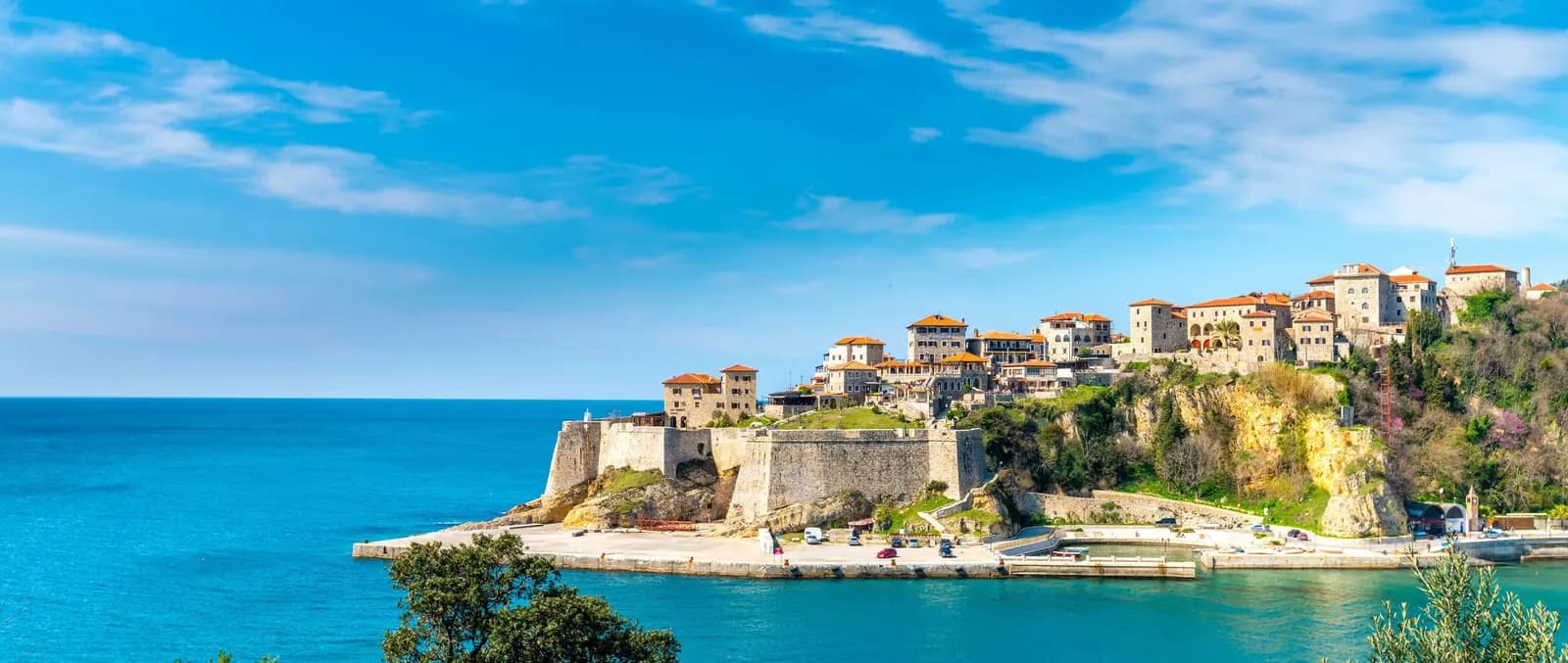
The Old Town (Stari Grad) is Ulcinj’s historic heart: a fortress quarter whose ramparts and tower rise straight from the sea above the town beach, with origins reaching back to an Illyro-Greek settlement and the Roman town of Olcinium. Montenegro’s UNESCO submission describes a fortified ensemble of roughly 29 hectares, protected nationally since 1961 and on the Tentative List since 2018 (entry 6300). Archaeological remains support settlement in the fourth or fifth century BCE; Ulcinj’s tourism organisation discusses fifth-century BCE fortification and objects, followed by Roman references. The honest formulation is archaeological continuity across Illyro-Greek and Roman worlds—not a neat claim that one named people “founded” everything visible today, and not a tidy sequence in which Greeks from Colchis found the town, it is destroyed, and it is rebuilt. Names, rulers and legends accumulated across a long record; they do not collapse into one uncontested origin story.
The headland’s current form is cumulative. Over the centuries it passed through Byzantine, Venetian and Ottoman hands. Medieval rulers and the Balšić dynasty shaped the citadel; Venetian rule introduced or rebuilt ramparts, gates, towers and Gothic-Renaissance forms; Ottoman rule after 1571 added an eastern Mediterranean urban and domestic layer. In the seventeenth and eighteenth centuries the town was a notorious corsair stronghold — home port to a pirate fleet said to number in the hundreds of ships. The earthquake of 15 April 1979 damaged the quarter severely, and the rebuilding that followed is itself part of what stands there. Old stone here is evidence, but so are repairs.
Today you wander stone lanes between old houses, ramparts and small museums, with sweeping views over the bay and Mala Plaža below. Landmarks include the clifftop castle and the Sailors’ Mosque, which local tradition says once served as a lighthouse — it is a separate building from Pasha’s Mosque a hundred metres away, and the two are routinely confused. Wear sturdy shoes — the cobbles and steps are uneven — and come early or late in the day to avoid the midday heat and crowds.
The dossier remains Montenegro’s case for possible future inscription, not UNESCO’s final endorsement of every historical proposition it contains, and it does not guarantee current interior access. That distinction is useful beyond legal status: look for changes in masonry, street width, vaulting and house form rather than trying to assign the whole fortress to one civilisation.
LAYERS, NOT A CLEAN REBUILD — simplified chronology of Ulcinj Old Town. Dates simplify overlapping material phases and later reconstruction.
Period
Layer
4th–5th c BCE
fortification
MEDIEVAL
citadel
1421–1571
Venetian
1571–1878/80
Ottoman
1961
protected
2018
tentative
Source: whc.unesco.org, ulcinj.travel
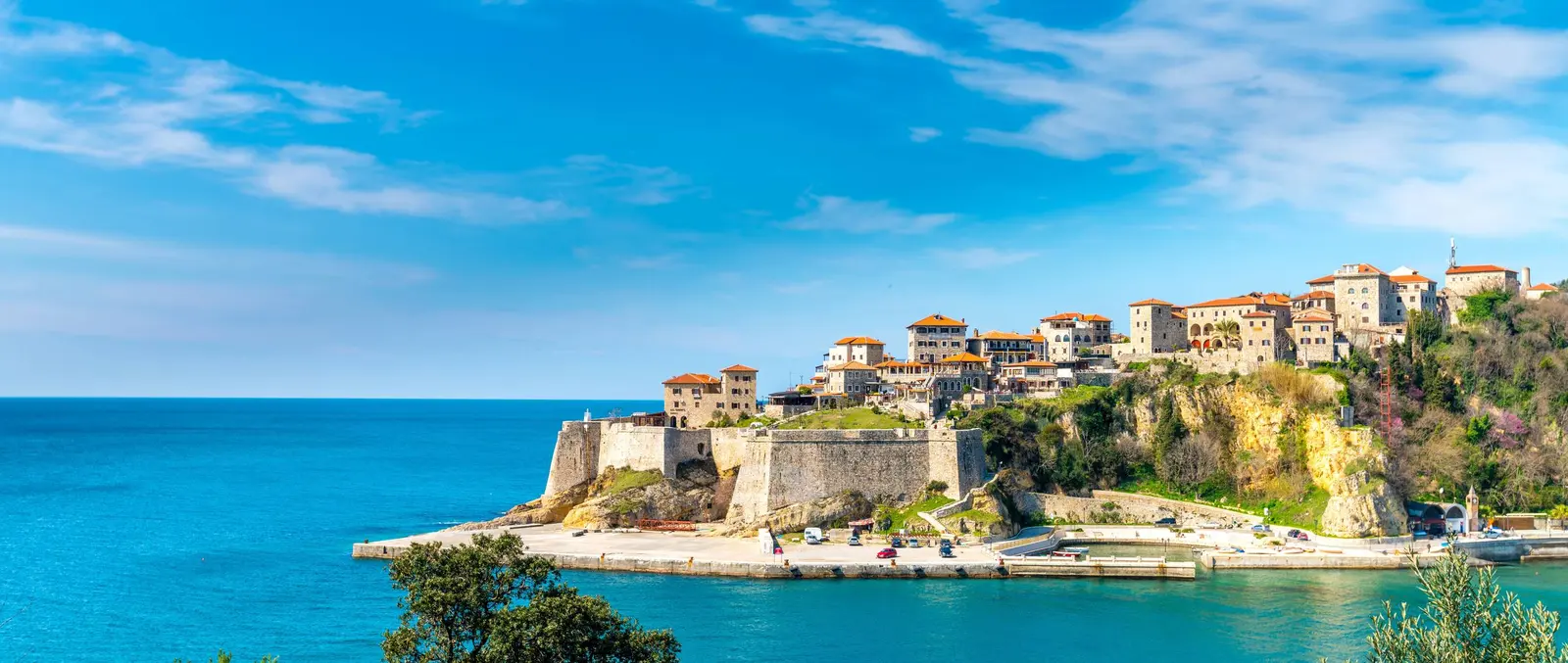
Ulcinj Old Town occupies a steep limestone headland. This archive view shows setting, not the age or authenticity of each visible building.
Four evidence layers for Ulcinj Old Town
Evidence layer
How to treat it
Archaeology: settlement evidence around the fifth century BCE
Attribute disputed origins carefully
Documented building layers: Church 1510, conversion after 1571
Verify current museum operation
National protection + UNESCO Tentative List
Not World Heritage inscription
Cervantes in Ulcinj
Legend, not documented biography
Source: whc.unesco.org, ulcinj.travel
The Church-Mosque: 1510 church, 1693 minaret
Inside the walls, the Church-Mosque makes Ulcinj’s layered history unusually legible, and it is the clearest single building case in town. The local tourism organisation dates St Mary’s church to 1510, its conversion to the Mosque of Sultan Selim II after the Ottoman conquest in 1571, and the cut-stone minaret added in 1693 at the expense of Hadži Halil Skura, who was its patron rather than its builder. The building now holds the archaeological department of the town museum; the art gallery is in the Balšić tower beside it.
That chronology is stronger than generic language about East meeting West, because it names changes of function and fabric. The building did not somehow serve both rites simultaneously; its religious use changed with political rule, and its present museum role is another phase. Read the fuller Church-Mosque history before visiting; the Church-Mosque guide also explains why present admission has to be verified rather than assumed.
Do not plan around an undated opening-hours snippet. Current hours, admission, accessible rooms and whether all collections are open should be confirmed with the museum or tourist information shortly before arrival. The Old Town’s steep, irregular lanes and thresholds should not be described as universally accessible; visitors with mobility needs need an exact route and entrance check.
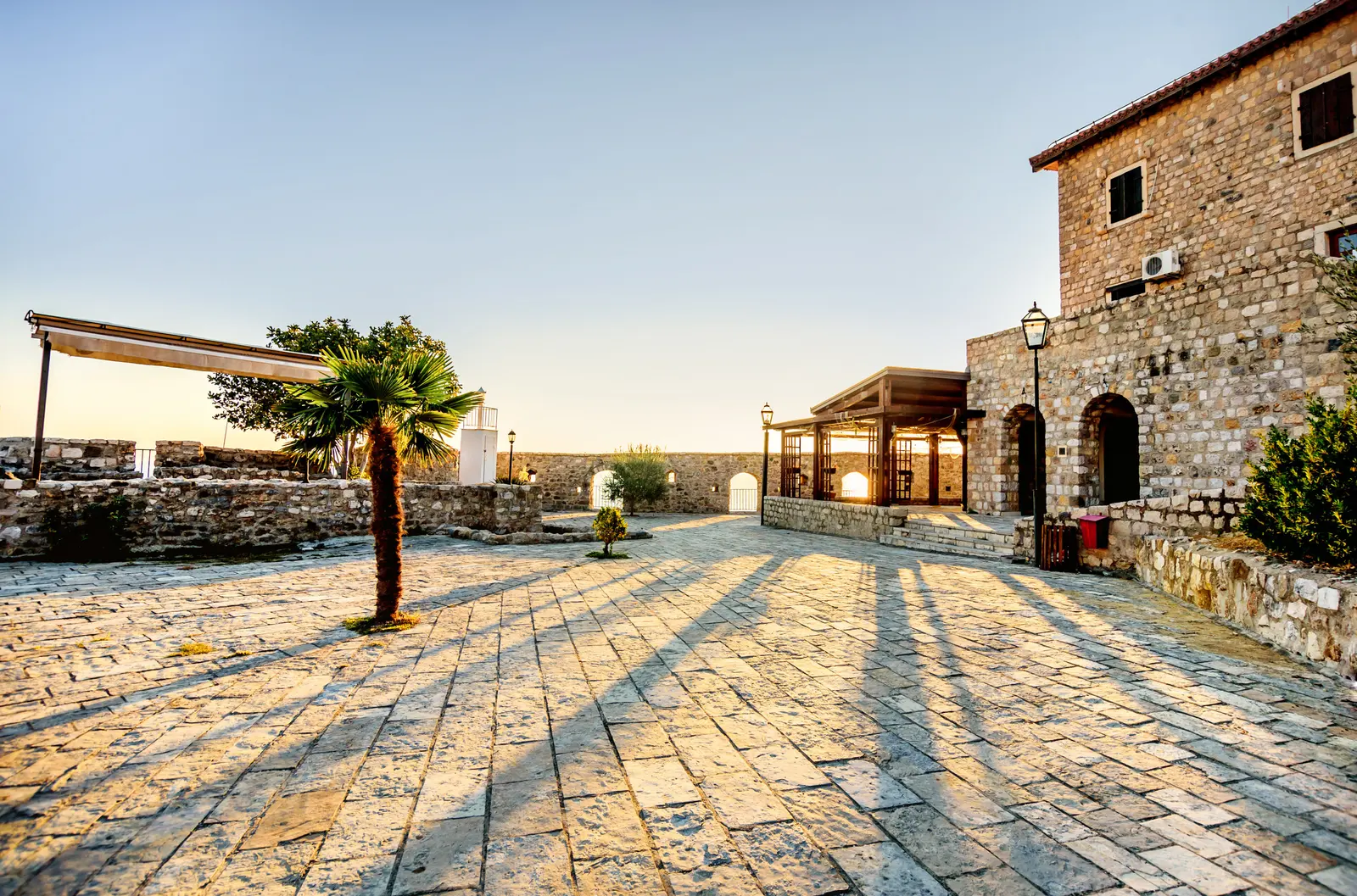
An interior Old Town courtyard in archive imagery. Present access, use and opening conditions require direct confirmation.
Corsairs, captivity and why Cervantes belongs to legend
Ulcinj’s Ottoman-era maritime history included corsair networks, captive-taking, ransom and sale. The local tourism organisation identifies the square before the Church-Mosque as a former slave market and describes captives taken around Italy and Dalmatia. That history should not be softened into pirate entertainment: the commodity was often a person whose family was pressured to pay. It deserves serious treatment.
The popular claim that Miguel de Cervantes was held in Ulcinj is different, and it does not become true through repetition. The Instituto Cervantes Virtual Centre places his captivity from 1575 to 1580 in Algiers. No comparable documentary chain places him in Ulcinj, and the proposed Dulcigno–Dulcinea wordplay is not proof. The responsible version is a local literary legend attached to a town with a real captive economy.
The dedicated Slave Square and Cervantes guide separates documented captivity, Adriatic corsair context and later storytelling; use the same distinction when a guide, sign or souvenir collapses them. A legend can illuminate civic memory without becoming a biographical fact.
The Sailors' Mosque guide applies the same method to another prominent landmark: building traditions, later reconstruction and current religious use need separate evidence and respectful visitor behaviour.
Documented Ulcinj captivity history versus Cervantes legend
Cervantes in Ulcinj; Dulcigno → Dulcinea; not documentary history
Source: ulcinj.travel, cvc.cervantes.es
A living Albanian-speaking municipality, not a museum set
MONSTAT’s 2023 census counted 20,507 residents in Ulcinj municipality. Of them, 15,233—74.28%—reported Albanian as mother tongue; Montenegrin accounted for 11.70% and Serbian 8.32%, with Bosnian at 1.97% and remaining responses in other categories. These are municipal data, not the urban settlement alone. They establish why Albanian is central to everyday civic and commercial life alongside Montenegrin and other languages, which remain visible.
Mother tongue is not a complete statement of ethnicity, religion, politics or the language an individual prefers with a visitor. Greet politely, follow the language offered by the person in front of you, ask rather than assume, and avoid treating multilingualism as exotic scenery. Treat mosques, churches and mixed-use heritage buildings as living spaces; dress appropriately, lower voices and ask before photographing worship or people at close range. The most important cultural fact about Ulcinj is that the Old Town’s inherited layers belong to a contemporary community.
Four coastal zones, four different decisions
One municipality, four beach logics. Mala Plaža is town-adjacent, the pine coast has rock coves and a women-focused beach, Velika Plaža holds many managed sectors, and Ada Bojana is a dynamic river-mouth shore. Choose the zone first, then verify its exact managed sector.
ONE MUNICIPALITY • FOUR BEACH LOGICS
Zone
Character
Note
MALA PLAŽA
town access
busy sectors
PINE COAST
rock coves
special access
VELIKA
many sectors
wind + services vary
ADA
river mouth
dynamic shore
Source: morskodobro.me, ulcinj.travel
Five sands, measured. Every length below is the figure a named source publishes, checked against the OpenStreetMap beach polygon on 11 September 2026. Where the two disagree, both are given — nothing here is a rounded guess, and the town’s own coast is more varied than the single 13 km figure the marketing runs on.
Velika Plaža — 12 km of sand running from Port Milena to the mouth of the Bojana, the longest beach in Montenegro. Shallow, warm, and divided into separately coded managed sectors rather than run as one operation; the southern end belongs to the kites. The OpenStreetMap sand polygon runs 9.8 km end to end and about 10.4 km round the curve of the shore, so the 12–13 km usually quoted counts the sand right through to the river.
Ada Bojana — about 3 km of ocean beach on the seaward side of the river island, behind it the naturist settlement and the stilt restaurants over the water. Three kilometres is what the English, Serbian and Albanian Wikipedias and Ulcinj’s own tourism organisation all say on their beach pages, and the OpenStreetMap polygon measures 2.9 km end to end; the 3,800 m that the same organisation gives on its river page is the outlier.
Mala Plaža — 360 m of sand directly under the Old Town walls, the town’s own beach: cafés along the back, water shallow enough to walk out in, and no space at all after ten in the morning in August. The OpenStreetMap polygon gives 334 m between its ends.
Valdanos — 300 m of shingle beach in a sheltered horseshoe bay north-west of town, under a grove of some 18,000 olive trees whose average age is put at anything from 500 to 800 years. Shaded, pebbly and far quieter than the sands; measured on the OpenStreetMap polygon, because no published figure could be opened.
Ženska Plaža — about 70 m of women-only cove fed by a sulphur spring, inside the pine belt east of the centre. Admission is charged, the hours are posted, and men are not admitted; the OpenStreetMap polygon measures 68 m between its ends, and no published figure could be opened.
Mala Plaža, the city beach at the foot of the walls
Mala Plaža sits directly below the Old Town and works for a compact town-and-swim day. The “Small Beach” is 360 m of fine sand — the tourism organisation reckons it holds about 2,500 sunbathers — and the social centre of summer Ulcinj: cafés, bars and hotels along the back, shallow water, and everything in town within walking distance. It is the obvious choice for a swim without leaving the centre, and it fills by mid-morning in July and August — come early, or use it as a base and take the bus out to the long sand for space. It is divided into managed sectors like every other Ulcinj beach, so crowding, free space, equipment and tariffs are read off the actual sign, not off the beach’s name.
Valdanos: the olive-grove bay
Valdanos is the quiet counter-argument to the long sand. North-west of town, past the pine belt of Borova šuma, it is a sheltered horseshoe bay of shingle beach set against a hillside of ancient olive trees — around 18,000 of them, and old enough that published estimates of the average disagree: 500 years and more in one Montenegrin account, 600 in another, 800 in the Ulcinj one. The grove is protected by name, not merely by category: Montenegro’s olive-growing and olive-oil law of 2014 lists the Maslinada Valdanos alongside Bar’s Stara Maslina and Budva’s Velja Maslina, and locally it is called the largest living monument of olive growing on the Adriatic. The trees are the reason the bay is shaded when the sands are not, and they are also the reason it is contested: the grove was expropriated in January 1978 by the Yugoslav federal defence ministry, the military base was never built and a services holiday resort opened instead in 1983, and the restitution claims that owners filed in 2010 are still being worked through. Decades of that are visible on the ground in dried trees, collapsed dry-stone walls and overgrown paths.
Between Valdanos and the resort sectors of Velika Plaža the coast holds pebble coves, the women-only spring at Ženska Plaža and the naturist stretches at the river end, which is why the choice of a zone matters more here than the choice of a beach. Come to Valdanos for shade, old trees and clear water; do not come for services, which are minimal and seasonal.
Ženska Plaža: verify rules, reject medical promises
Closer to town, the small Ladies’ Beach (Ženska Plaža) is a women-focused cove fed by sulphur springs and known locally for its mineral water and mud; it has traditionally been a women’s bathing spot. That specific women-only operating tradition and the spring are documented facts, but they do not establish a fertility treatment or any other medical outcome. Admission is listed at €2, and the hours at 08.00–18.30, women only; seasonal operation, privacy expectations and photography restrictions still have to be confirmed on the day, because this is the one beach in the municipality where getting it wrong is a personal intrusion rather than an inconvenience. Use the evidence-led Ženska Plaža guide rather than medical folklore; the same guide distinguishes published site history from health claims.
Never photograph over a wall, from a drone or with a long lens. Do not test access rules in person when a phone or official check can settle them. Anyone with a medical condition should seek clinical advice rather than using an unverified spring claim to make a treatment decision.
Velika Plaža (Long Beach)
Velika Plaža is Ulcinj’s headline attraction and one of the most-reviewed sights in town — a long sandy system, not one uniform beach club. It runs 12 km from Port Milena south-east to the Bojana and the Albanian border — the longest beach in Montenegro, on a coast that is otherwise all stone. The sand is fine and the water shelves so gently that you can wade out a hundred metres and still stand, which is why families fill the middle of it. The near end begins about 5 km from the town centre; the club strip at Donji Štoj is 14 km and 23 minutes by road, measured with OSRM on 11 September 2026. The seasonal beach bus from the town market runs at €1.50 and a taxi is about €7 each way.
Sections of the beach are managed resort areas (with names such as Miami, Tropicana and Safari) offering sunbeds, bars and watersports, several of them Blue Flag–certified, while long stretches in between stay wild and quiet. Morsko Dobro’s register shows numerous coded Ulcinj sectors and agreements, including many on the long beach. Wind-sport zones, swimming areas, lifeguards, free-use space, facilities and tariffs all differ between them. A sunbed and parasol set costs €15 to €40 depending on the club, and the gravel lots behind most of them are free — but no club on this beach publishes a tariff, that band comes from one travel guide, and the spread is the point: the price is the club’s, not the beach’s. Parking in town is a different matter, and Mala Plaža sits in a paid zone. The Long Beach guide helps choose a section, and the posted rules at the one you pick are what actually control.
Licensed aerial overview of Ulcinj’s long sandy coast. It does not identify a managed sector, current facility or safe swimming area.
Ada Bojana: the river island
Ada Bojana lies at the far south of the sand, where the Bojana meets the sea: a triangle bordered by the river on two sides and the open Adriatic on the third. Its size is one of the things the sources do not agree on — Wikipedia gives 4.81 km², Ulcinj’s own tourism organisation 600 hectares, which is a quarter as much again. The same organisation tells the island’s origin as a legend rather than a record: in 1858 the ship Merito, owned by Antun Alegreti of Trogir, is said to have sunk at the river mouth, the wreck and two existing islets held the sediment, and the island became visible in 1882. What the Skadar archives do document for the same years is that the Drim changed course in 1858–59 and began emptying one arm into the Bojana, which is the part of the story that does not need a shipwreck. Its seaward beach is about three kilometres, the figure the Wikipedias and the organisation’s own beach page give, against 2.9 km on the OpenStreetMap polygon and an outlying 3,800 m on its river page. The naturist resort opened to tourists in 1973, and the island takes clothed visitors too. The signature meal is at one of the wooden stilt restaurants over the river. It is 20 km and a thirty-seven-minute drive from the Old Town, measured with OSRM on 11 September 2026: allow far more than the quarter of an hour the map suggests, because the last stretch is a slow lane across the back of the beach.
Ulcinj’s tourism organisation itself notes that river arms and beach shape change from year to year. Treat map pins, shore access and water channels as dynamic, and do not freeze old island dimensions, naturist arrangements, restaurant lists and water-sport claims into a 2026 plan. Confirm the current road, operator, beach rules, wind and return. Confirm the exact venue’s dress policy too; “Ada Bojana” does not make every surrounding space automatically naturist. There is a charge to bring a vehicle onto the island, and it falls on the vehicle, not on the person. HTP Ulcinjska rivijera introduced it in June 2025 at €1 an hour to a €10 daily maximum until the end of that month, then €2 an hour between six in the morning and six in the evening from 1 July to 15 September, €1 an hour overnight, and a €10 day ticket throughout the season. Anyone who walks or cycles across goes free, and guests of the island’s own rentals are covered by the €10 ticket. No 2026 tariff has been published and the operator’s website carries no price list, so treat the 2025 figures as the shape of it and expect to pay at the barrier.
The Bojana above Ada on 21 September 2026: fish restaurants on piles along both banks, and the river the colour of jade.
Beach choice begins with a sector, not a name
The coastal manager’s register divides Ulcinj into many separately coded bathing sectors. Mala Plaža, the Borova šuma coast and Velika Plaža contain distinct entries rather than one continuous operation. A claim about loungers, lifeguards, free space, dogs, kitesurfing or accessibility at one sector cannot be copied along the coast.
On arrival, read the actual board. Confirm the operator, sector limits, equipment price, free-use allocation, lifeguard hours, flag meaning, buoy line and any activity zone. Photograph the sector code and tariff before renting equipment. Ask where the free-use area begins, what the price includes, when equipment must be returned, and whether the lifeguard is on duty. A map pin that says only “Long Beach” has not completed this task. The dedicated Velika Plaža guide explains how to select a named sector and separate swim space from wind-sport operations.
Kitesurfing & watersports
Ulcinj is widely regarded as Montenegro’s kitesurfing and windsurfing capital. The action centres on the southern end of Velika Plaža (roughly the final couple of kilometres before the river) and around Ada Bojana, where the flat, shallow water and steady summer wind create near-ideal conditions for beginners and freestylers alike. The reliable draw is the Maestral, a thermal sea breeze that builds through the afternoon. How hard it blows depends who you ask: the school on the sand describes a side-onshore wind almost every day of the season at 15 to 20 knots, while Adriatic Ways puts it at 14 to 25 knots from about one o’clock until sunset. Windfinder has published no wind statistics for Ulcinj since 2017, so there is no long record to settle it: plan the afternoon and read the forecast the night before. Several kite schools and rental centres operate along this stretch in season, offering lessons, gear hire and storage. If you are coming specifically to ride, the warm, wide, uncrowded southern sands are the reason Ulcinj beats the rest of the Adriatic for it.
Wind-sport space and swimming space are separately managed. Ask each sector where its swim area ends, and never cross activity buoys, enter a kite launch corridor or swim behind an anchored craft to find quieter water.
WHAT KITING COSTS — Ka’banya’s published tariff on Velika Plaža, with the wider beach band beside it
Lesson or hire
Alone
In a pair, each
Taster, two hours
€140
€100
Beginner course
€480 for 8 h
€420 for 12 h
Private hour
€75
—
Whole kit, one day
€70
—
Whole kit, five days
€260
—
Kite / board / harness, one day
€45 / €25 / €10
—
Storing your own kit, one day
€10
—
Beginner course, estimated for the rest of the beach
€350–€500
—
Source: kitesurfmontenegro.com, adriaticways.com
Those are one school’s published prices and one guide’s band for the rest; nobody on this beach publishes a common tariff, and the wind season the prices assume runs from the beginning of May to the end of September. Settle in writing what happens to a booked multi-day course on a windless week before paying for it; none of the schools we opened states a no-wind policy on its own site.
The Salina: Ramsar site 2399
Inland from the beaches, the Ulcinj Salina (salt pans) is one of the most important bird habitats on the eastern Adriatic. The Convention on Wetlands designated it as Ramsar Site 2399 on 1 July 2019. Ramsar calls the 1,477-hectare former saltworks the largest salina on the Adriatic and the most important wintering, nesting and feeding site for birds on the eastern Adriatic coast, and records 252 bird species in it, 20 of them globally threatened. Greater flamingo, Dalmatian pelican and Eurasian spoonbill are the birds people come for, and BirdLife International lists the pans as an Important Bird Area. The pans were built in the 1930s and salt production stopped in 2013; the ecological system remains tied to the water regimes created for evaporation and crystallisation, which is why Ramsar also warns that the salt-flat vegetation is now at risk of being crowded out by commoner plants.
Spring and autumn bring the largest numbers, but the pans are rewarding from roughly April to October; early morning and late afternoon are best for both light and bird activity. Bring binoculars, or join one of the local guided birdwatching tours that combine the Salina with the surrounding olive groves. It is a quiet counterpoint to the busy beaches.
Those species figures are site-wide conservation records across time, not a same-day list. Ramsar status is not a guarantee that flamingos will be visible, that every dike is open, or that visitors can enter without prior arrangement. Access, water management, viewing areas, guides and species presence can change. Entry at the old saltworks gate on Solanski put was €2.50 in 2026 and the gate opens at 07.00; the guard may ask to see identification, and the drive from the Old Town is 6.5 km and twelve minutes, measured with OSRM on 11 September 2026. Check current access, hours, route and guide options directly, verify permission before travelling, carry optics and keep distance from birds, and do not enter operational or sensitive zones unannounced. Use the dedicated Ulcinj Salina guide for conservation context, but let current site management control the visit.
Water and beach services are exact-site questions
Morsko Dobro provides a live sanitary bathing-water map. Before swimming, select the exact monitored point nearest your chosen sector and read the newest dated result. A result for Mala Plaža cannot be reassigned to a distant Long Beach section; a municipality percentage is not a sample.
Two August rounds show why municipal averages are useful but insufficient. For samples taken 3–7 August 2026, Ulcinj had 15 excellent, one good and two satisfactory monitored locations. For 17–21 August, it had 14 excellent, three good and one satisfactory. Neither round reported a poor Ulcinj location, but the distribution changed and the national notices did not map those classes to your chosen beach in the summary.
Open the official site-level portal, select the exact location and read the sample date as well as the class. Then check the on-site flag and any newer notice. Finally assess weather, wind, waves, currents, visibility, vessel or board-sport movement and personal ability. If signals conflict, follow the more restrictive one. Shallow-looking water is not a safety certification.
FROM MAP PIN TO SAFE DECISION — five checks at an Ulcinj beach sector. No town-wide adjective replaces the exact beach check.
Check
What to read
SECTOR
exact code
SIGN
rules + tariff
SAMPLE
newest date
FLAG
conditions
ZONES
swim / sport
Source: morskodobro.me, monitoring.morskodobro.me
Do not use colour, sand texture or shallow appearance as a water-quality test. Children need direct supervision even in apparently gentle water. Never cross activity buoys, enter a kite launch corridor or swim behind an anchored craft to find quieter water.
Where to eat in Ulcinj
Ulcinj’s kitchen sits at the meeting point of Montenegrin and Albanian cooking, with a strong Adriatic seafood backbone. Expect fresh fish and shellfish, grilled meats, Balkan grills and burek, and the river fish specialities served at the stilt restaurants on Ada Bojana. The Old Town and Mala Plaža have the densest cluster of restaurants and cafés, while Ada Bojana is the destination for a leisurely seafood dinner over the water. Local olive oil — pressed from those ancient groves — turns up everywhere and makes a good edible souvenir, along with handmade goods from the town’s craft shops.
Where to stay in Ulcinj
Three zones, and the choice between them decides how the days run. The Old Town and Mala Plaža put the historic quarter, the city beach and the evening within walking distance, and take the long sand by bus or taxi. Velika Plaža puts you on the sand and the kite water and four to fourteen kilometres from the walls. The Ada Bojana end, around Donji Štoj, is the quiet edge of the municipality where the sand meets the river; it needs a car. Ulcinj is generally better value than the headline resorts further north, and the gap widens in June and September.
Thirty-four places in Ulcinj are listed on this site — twenty-one apartments, nine hotels, three villas and a cottage — and each of them takes an enquiry straight to the owner rather than through an agency. Six, spread across the three zones:
Naturist visitors have dedicated accommodation on and around Ada Bojana itself, which is booked through the settlement rather than through general listings.
How to get to Ulcinj
Ulcinj sits at the southern end of the Montenegrin coast, beyond Bar. The Sukobin crossing into Albania is 29 km and thirty-seven minutes away; Podgorica airport is 74 km and about an hour and a half, Tivat 86 km and about two hours, both measured with OSRM on 11 September 2026. Tirana in Albania is a third option and often the cheapest flight for the deep south.
By bus: the station is the end of the coastal line, with services from Bar, Budva, Kotor and Podgorica in season. Bar is 29 to 47 minutes away and costs €3.35 to €4.85 depending on which company’s coach you board — the bus station’s own timetable lists sixteen to nineteen departures a day at four different fares, and the aggregators list about twice as many services without printing a price at all. Podgorica is 78 km and about an hour and three quarters, at €7 through gjirafa and €7.70 to €8.70 on the station timetable. The station is about 2.5 km from the town centre, a half-hour walk or a short taxi.
By car: driving is the only practical way to link the Salina, Valdanos, the long sand and the river island, which lie in three different directions from the walls. The coastal road down from Bar is straightforward and Ulcinj is the last town on it before the Sukobin crossing into Albania; allow extra time through July and August, when the single road out to the long sand carries the whole riviera.
By taxi or transfer: short hops around town are a few euros and the run out to the long sand is about €7 each way. From Podgorica airport both local firms quote €90 for a car — taxipodgorica.com and taxipg.com — and taxipg says the tunnel toll is included, though it puts that toll at €5 when Monteput’s own tariff charges a car €2.50 for Sozina. Ada Bojana is €100 rather than €90. Agree the fare before setting off; almost nothing here runs on a meter.
Every fare above was read off a live page on 11 September 2026. The bus prices are the carriers’ own as the station sells them and differ by company on the same route; none of them, and none of the taxi quotes, is a tariff you can hold anyone to. Treat them as the shape of the price.
Getting around Ulcinj and moving between zones
The Old Town and Mala Plaža are compact and walkable, but Ulcinj’s main draws are spread along the coast: the long sand starts about 5 km out and its club strip is 14 km, Ada Bojana is 20 km and thirty-seven minutes by road, the Salina gate 6.5 km and twelve minutes inland, and Valdanos 6.7 km and eleven minutes the other way. In summer, seasonal shuttle buses and minibuses run from town to Velika Plaža, taxis are cheap, and many visitors rent a car, scooter or bike to link the beaches and the river island at their own pace.
The city core, Velika Plaža, Salina and Ada Bojana are not one walkable cluster. Build each day around one geographic zone and solve the return before leaving the first. Current congestion, parking controls, road works, event closures and transport frequencies can change, so treat every drive time and timetable above as indicative and confirm it locally rather than relying on a fixed figure in an evergreen guide.
If staying near the city centre, confirm whether accommodation parking is reserved, on site and accessible through the exact street. Old Town approaches include slopes, steps and uneven stone. Drop luggage before entering the narrowest area when the host provides a lawful arrangement. For a beach day, ask the sector for its precise entrance rather than following the first “Velika Plaža” pin.
If continuing south across the border, treat it as a separate transport day. The Montenegro-to-Albania guide covers the documents, the crossings and the queues, all of which need rechecking on the day. A beach outing should not depend on an unverified border schedule.
The Old Town walls and cliffs above the Adriatic.
What Ulcinj costs in 2026
Ulcinj is cheap by Montenegrin coastal standards, but very little here is posted in advance: no beach club on the long sand publishes a sunbed tariff, no cultural body prices the museum, and the charge for driving onto Ada Bojana was last announced for the 2025 season. Every figure below was checked on 11 September 2026 and carries the source it came from, because on this coast who says a price matters as much as the price. Where only one source publishes a figure, the table says so instead of letting it pass as settled.
Ulcinj prices, checked 11 September 2026. Only the tunnel toll is an official tariff.
What
2026 price
Where the figure comes from
Old Town museum, inside the Church-Mosque
€2
Montenegro Pulse, undated, which also gives 09.00–20.00 from 1 May to 30 October and 08.00–15.00 the rest of the year, closed Mondays. It is the only source publishing either, nothing official states a price, and the museum’s own domain no longer resolves. Carry coins
Ulcinj Salina, entry at the saltworks gate
€2.50
birdingplaces.eu, updated 25 April 2026; gate opens 07.00, identification may be asked for
Ženska Plaža admission
€2
montenegrofortravellers.com; listed 08.00–18.30, women only
Sunbed and parasol, Velika Plaža clubs
€15–€40 a set
Adriatic Ways, undated — the spread is between clubs, and no club on this beach publishes a tariff of its own
Sunbed and parasol, Ada Bojana
€15 a set
Adriatic Ways, undated: two loungers and a parasol, at the naturist resort’s own beach zone
Parking, Velika Plaža clubs
generally free
Adriatic Ways — gravel lots behind most of them. Free at the clubs is not free in town: the same publisher puts Mala Plaža in a paid SMS zone at about €0.90 an hour, and the municipality publishes no tariff for either
Taking a car onto Ada Bojana
€2 an hour, €10 a day
HTP Ulcinjska rivijera’s announced 2025 season tariff: €2 an hour 06.00–18.00 from 1 July to 15 September, €1 an hour overnight and before July, €10 a day throughout. Walkers and cyclists free. No 2026 tariff published
Kite taster, two hours
€140 alone, €100 each in a pair
Ka’banya, kitesurfmontenegro.com
Kite beginner course
€480 alone for 8 h, €420 each in a pair for 12 h
Ka’banya. Adriatic Ways estimates €350–€500 for a 9–12 h course elsewhere on the beach, but it is an estimate, and the one school that publishes sits above the top of it
Kite private hour
€75
Ka’banya
Kite kit hire
€70 a day, €260 for five days
Ka’banya; kite alone €45, board €25, harness €10, storage €10 a day
Bus, Ulcinj to Bar
€3.35–€4.85
autobusni-kolodvor’s timetable, priced per carrier: €3.35, €3.85, €4.35 and €4.85 all run. Sixteen to nineteen departures a day, 29 to 47 minutes
Bus, Ulcinj to Podgorica
€7–€8.70
gjirafa averages €7 over five bookable departures; autobusni-kolodvor sells the same route at €7.70 and €8.70. 78 km, 1 h 35 to 1 h 56
Seasonal beach bus, town to the long sand
€1.50
Adriatic Ways, undated — from the town market; the tourist board publishes nothing about it
Taxi, town to the long sand
about €7 each way
Montenegro Pulse
Taxi or transfer, Podgorica airport
€90 a car
taxipodgorica.com and taxipg.com both quote €90 to Ulcinj and €100 to Ada Bojana; taxipg says the tunnel toll is included
Sozina tunnel toll, one car
€2.50
Monteput’s published tariff — second category. €5 is the three-axle rate, and some transfer firms quote it as if it were the car rate
Diving, guided dive
from €15
Montenegro Pulse, quoting D’Olcinium Diving Club — whose own web address no longer resolves, so ring before counting on it
Two of those rows are thinner than they look. Nothing official prices the Old Town museum: the €2 and the opening hours come from a single undated travel guide, the museum’s own web address no longer resolves, and no Montenegrin cultural body publishes either. Ada Bojana’s vehicle charge is a 2025 announcement, not a current tariff — the operator has published nothing for 2026 — and the thing people repeat about it, that the island charges per head at the bridge, is wrong: on foot or by bicycle the crossing is free. Both figures are worth confirming at the counter.
Best time to visit Ulcinj
July and August are the warmest and liveliest months, with the fullest beach scene and the most reliable kitesurfing wind — but also the biggest crowds and highest prices. June and September are the sweet spot for most travellers: warm sea, long days and noticeably fewer people. May and October are cooler and quieter but pleasant for sightseeing, walking the Old Town and birdwatching at the Salina, which is at its best in spring and autumn migration. Whenever you come, the early morning and the hours before sunset are the most rewarding times for both the beaches and the Old Town.
Day trips from Ulcinj
Ulcinj is the last town before Albania, and what is worth a day out of it lies north up the coast, inland to the lake and the capital, or over the border. The times and distances below were routed with OSRM on OpenStreetMap data on 11 September 2026, from the Old Town gate. They are free-running times: they know nothing about the July queue at the Bar roundabout or the line at the border, and the two longest of them are long because the roads are, not because the map is wrong.
Ulcinj Salina (12 minutes, 6.5 km) — the Ramsar wetland on the town’s doorstep, €2.50 at the saltworks gate. Go at first light; by eleven the birds are distant and the heat is not.
Ada Bojana (37 minutes, 20 km) — twenty kilometres of road for a place visible from the end of the beach, because the last stretch crosses the back of the sand at walking pace.
Stari Bar and Bar (38 minutes, 27 km) — a ruined walled hill town under the mountain, Venetian until 1571 and Ottoman until 1878, with the working port and the railway inland on the shore below it.
Sutomore (52 minutes, 36 km) — the nearest resort sand that is not Ulcinj’s own, and the railway station for anyone heading inland without a car.
Virpazar and Skadar Lake (68 minutes, 50 km) — boat trips into the national park from a village of a few dozen houses. The birding complements the Salina rather than repeating it: lake and lagoon hold different species.
Shkodër, Albania (68 minutes, 45 km) — over the Sukobin crossing, itself 29 km and thirty-seven minutes from town. Treat the border as its own day and check the queue before leaving, not after.
Podgorica (104 minutes, 81 km) — the capital and the airport, via Bar and the Sozina tunnel. Long enough that it is a travel day rather than an outing.
A practical two-day Ulcinj plan
Day one—town and history. Start in the cooler morning at the Old Town. Read the fortification as layered fabric, then visit the Church-Mosque museum only after confirming that day’s access. Give the corsair square its documented human context and keep Cervantes as legend. Descend toward Mala Plaža, but choose a swim only after checking the exact sector and water result. Evening belongs to the living town below the walls, not another monument checklist.
Day two—one southern landscape. Choose either Velika Plaža and Ada Bojana, or the Salina; combining all three can turn the day into traffic and parking. Beach visitors verify sector, wind, water and return transport. Bird visitors verify Salina entry and stay on permitted routes. If continuing south, treat the border as its own day.
Ulcinj planning matrix
Priority
Best starting zone
Main evidence check
Common wrong assumption
Layered history
Old Town
Museum access and exact route
Tentative List means World Heritage
Town + swim
Mala Plaža
Sector sign, water result, flag
One beach name means one operator
Sand + space
Velika Plaža
Exact access, sector and wind zones
Every section has identical services
Naturist context
Ada Bojana
Venue policy and changing shore access
The whole delta has one dress rule
Birding
Salina
Current entry, route and sightings
Ramsar status guarantees access/flamingos
TWO DAYS • TWO DIFFERENT SCALES — a two-day Ulcinj visit sequence
Day
Plan
DAY 1 • TOWN
Old Town + museum check; living centre; optional exact-site swim
DAY 2 • LANDSCAPE
Velika + Ada OR confirmed Salina; do not rush all three
Call Montenegro’s national number 112 for a serious emergency. State Ulcinj municipality, the exact beach sector, Old Town gate, road, Salina entry or river-mouth landmark, and whether the incident is in water, on stone steps, in traffic or in a wetland zone. Reception, access and response time are not guaranteed.
Heat, slippery polished stone, exposed steps, surf, currents, wind-sport equipment and road congestion are different hazards. Carry water and shade, use footwear suited to both sand and stone, keep children directly supervised and stop when the plan no longer matches conditions.
Is Ulcinj worth visiting?
Yes — especially if you want sand, history and something distinct from the rest of the coast. Ulcinj combines Montenegro’s longest sandy beach, a clifftop Old Town with two millennia of history, the unusual river island of Ada Bojana, the best kite water on the Adriatic and a flamingo-filled nature reserve, all wrapped in a lively Montenegrin-Albanian culture. The one condition is method: choose your zone, then verify the specific sector, museum, entry point or venue rather than trusting a coast-wide promise.
Frequently asked questions
Is Ulcinj Old Town a UNESCO World Heritage Site?
No. It is a nationally protected cultural property and has been on Montenegro’s UNESCO Tentative List since 2018 (entry 6300). Tentative status is a preliminary national submission, not inscription, and should not be marketed as full UNESCO listing. The nominated ensemble covers about 29 hectares and the quarter has been under national protection since 1961.
Was Cervantes imprisoned in Ulcinj?
There is no documentary evidence used here that places him in Ulcinj. The Instituto Cervantes Virtual Centre documents his 1575–1580 captivity in Algiers. The Ulcinj and Dulcinea connection is a local legend, not proven biography. The corsair economy behind it is real enough without him: Visit Montenegro puts the town’s 17th-century fleet at 500 two-masters, more than 400 ships were counted in the Ulcinj navy in 1818, and Article XV of the treaty signed at Passarowitz on 21 July 1718 forbade piracy to the coast under the fortress of Dulcigno in the same clause as Algiers, Tunis and Tripoli.
Which languages are spoken in Ulcinj?
What the sources say
Albanian is the dominant mother tongue in municipal census data, alongside Montenegrin, Serbian, Bosnian and other responses. MONSTAT’s 2023 census records 15,233 of 20,507 residents — 74.28% — giving Albanian, against 11.70% Montenegrin and 8.32% Serbian. Individuals may use several languages; follow the language offered rather than making assumptions.
How is Velika Plaža divided between operators?
Not as one operation. It contains many managed sectors, some run as named resort areas with sunbeds and bars, others left wild, and Morsko Dobro’s register codes them separately along all 12 km of it. Read the exact sign for operator, tariff, free area, services and activity zones — a sunbed set runs €15 to €40 depending on the club — then use the newest nearby bathing-water result.
What is the best beach in Ulcinj?
There is no universal best sector, and the five differ in kind rather than quality: Velika Plaža runs 12 km, Ada Bojana’s sea side about 3 km, Mala Plaža 360 m, Valdanos 300 m of shingle and Ženska Plaža a 70 m women-only cove. Choose by exact location, current water result, flag, wind, activity zoning, access and shade. “Velika Plaža” alone is not a precise destination.
Why is Ženska Plaža women-only, and is it therapeutic?
The women-only tradition and the sulphur spring are both documented; a fertility or any other medical outcome is not. Admission is listed at €2, and the hours at 08.00–18.30 to women only. Confirm current operation and privacy rules on the day, and seek qualified medical advice for any health decision rather than acting on a spring’s reputation.
Will I see flamingos at Ulcinj Salina?
Ramsar records the site’s high bird diversity across time and the full site, not a guaranteed sighting. Season, water level, disturbance and access matter. The designation covers 1,477 hectares and 252 recorded species, twenty of them globally threatened, but a species list is not a day’s sightings. Entry at the saltworks gate was €2.50 in 2026 and the gate opens at 07.00. Confirm current conditions and use optics at a respectful distance without disturbing birds.
Is Ada Bojana entirely naturist?
Ada includes a well-known naturist resort context established in 1973, but do not project one dress rule onto every beach, restaurant, road or riverbank, or assume a stable island-wide rule. Confirm the exact venue’s policy and current operator boundaries and signage; shoreline, river arms, access and operations can change from year to year.
Can I see Ulcinj in one day?
Yes, if you limit the plan to the Old Town and one nearby beach or dry coast stop. Velika Plaža, the Salina and Ada Bojana deserve separate live checks and should not be compressed into one day: the Salina gate is twelve minutes from the Old Town and Ada Bojana thirty-seven, and neither is on the way to the other.
A brief history of Ulcinj
Nine periods built the headland, and each one is still legible in the stone. Where two sources disagree — and on this coast they often do — both are printed with their attribution rather than averaged into a number nobody stands behind.
5th century BC: the Illyrian and Greek headland
The town is traditionally dated to the 5th century BC. Both the English and Serbian Wikipedia articles repeat a tradition — English Wikipedia calls it a belief, Serbian one theory among others — that colonists from Colchis founded it; Visit Montenegro’s history instead attributes the founding to Illyrians and puts traces of the first settlements earlier still. Neither account can be checked against anything on the ground, and they cannot both be right. What the archaeology supports is narrower and more useful: a fortified Illyro-Greek settlement on this headland, later absorbed rather than swept away, which is why the walls read as layers instead of as one design.
163 BC: Roman Olcinium
In 163 BC the Romans took the town from the Illyrians and it became Olcinium. Serbian Wikipedia gives that year outright; Visit Montenegro dates the conquest more loosely to the 2nd century BC and names the Illyrian Olciniates as the people who held it before. English Wikipedia has the town breaking with King Gentius and going over to Rome in 168 BC, during the Third Illyrian War, on the authority of Livy. The two do not sit easily together — a town that had already changed sides in 168 is an odd thing to conquer in 163 — and no source reconciles them, so both are here rather than one. The Roman name survives three times over: in Ulcinj, in the Venetian Dulcigno and in the Albanian Ulqin.
1183: Nemanjić rule and the Balšić lordship
In 1183 the Serbian grand župan Stefan Nemanja took Olcinium, and the town spent the next two centuries inside the medieval Serbian state and then under the Balšić family, whose power in Zeta peaked under Đurađ Stratimirović Balšić between 1385 and 1403. The Balšić tower, fifteen metres from the Church-Mosque across the old slave square, is what is left of them above ground, and it holds the town museum’s art gallery. Their dealings with Venice are what brought the republic to the headland in the first place; Balša III held Zeta until 1421, when it passed to Stefan Lazarević.
1405: Venice on the headland
Venice first took Ulcinj in 1405, had to hand it back to the Balšići in 1412, and held it again from 1421 until 1571 — those dates are Serbian Wikipedia’s, and Visit Montenegro’s flat “150 years” of Venetian rule from 1405 is the rounded version of the same stretch. The ramparts, the gates, the towers and the Gothic-Renaissance doorways in the Old Town belong to this period, as does the name Dulcigno, which four centuries later supplied the wordplay behind the Cervantes legend.
1571: the Ottoman conquest and the corsairs
In 1571 the Ottomans took Ulcinj from Venice with the help of North African corsairs, weeks before Lepanto, and held it for just over three centuries. The fleet is the part everyone repeats, and the numbers wander: Visit Montenegro writes that in the 17th century the fleet of Ulcinj had 500 two-masted ships in the Mediterranean, while the firmest count anyone has published is a later one — more than 400 ships in the Ulcinj navy in 1818. What is not in doubt is that it was worth a treaty. Article XV of the Venetian–Ottoman settlement signed at Passarowitz on 21 July 1718 bound the Porte to stop the Algerians, Tunisians and Tripolitans and, in the same clause, the inhabitants of the coast under the fortress of Dulcigno, from practising piracy — and from building the ships to do it in. What that economy actually consisted of — captives, ransom and a slave market on the square in front of the Church-Mosque — is set out in the corsair chapter above, and it is the reason this period should not be sold as pirate entertainment.
1880: the great powers hand Ulcinj to Montenegro
In 1880 Ulcinj changed hands, and it was a consolation prize. The Congress of Berlin two years earlier, in 1878, had awarded Montenegro Nikšić, Podgorica, Bar and the district of Plav and Gusinje — not Ulcinj; Albanian resistance made Plav and Gusinje impossible to take, so the powers reversed that award and offered this town instead. Even then the Ottoman garrison would not go until a combined British, French, German, Austrian and Russian fleet appeared offshore, the episode the period knew as the Dulcigno demonstration. Serbian Wikipedia dates the entry of Montenegrin troops to 26 November 1880; an American legation dispatch written the following week puts the occupation on the 27th, two thousand men and not a shot fired. Either date is the hinge of the town’s modern history: a Muslim, Albanian-speaking port handed to an Orthodox principality, which is a large part of why Ulcinj still feels unlike anywhere else on this coast.
1912: the Balkan wars and the First World War
In 1912 Montenegro went to war with the Ottoman Empire across this border, and the decade that followed put Ulcinj under occupation twice: Austria-Hungary took the town in 1916, Italian forces arrived on 4 November 1918, and the Podgorica Assembly of that year ended Montenegro’s separate statehood. The frontier with Albania that sits thirty-seven minutes down the road was drawn in this period and has not moved since.
1944: the Yugoslav decades
Yugoslav Ulcinj begins on 26 November 1944, when Partisan units took the town; an Allied bombardment on 7 November 1943 had killed more than forty-six people the year before, and the municipality had spent 1941 to 1944 under Albanian administration. The naturist settlement on Ada Bojana opened to tourists in 1973. The earthquake of 15 April 1979 damaged the Old Town badly enough that a good deal of what stands there today is conservation work rather than original fabric — which is the single most useful thing to know before reading the walls as ancient. Salt-making at the Salina ran through the whole period and stopped in 2013.
2006: independence and the years since
In 2006 Montenegro voted to leave the state union with Serbia, and Ulcinj became a town in an independent country for the first time since 1918. The two decisions that have shaped it since were both about land and water rather than politics: the Salina was designated Ramsar Site 2399 in 2019, six years after the salt stopped, and the Old Town went onto Montenegro’s UNESCO Tentative List in 2018 as entry 6300. Neither is finished business. The wetland depends on water regimes built for evaporation and now maintained for birds, and the dossier is a case for inscription rather than an inscription.
Compare
The beaches, to scale
Velika Plaža12 km
Sand · Family
Ada Bojana3 km
Amenities
Mala Plaža360 m
Sand
Valdanos300 m
Shade · Quiet · Pebble
Ženska Plaža70 m
Shade
Written by
Alex Obradovic
···
Updated · Originally published
Montenegro Travel Newsletter
Get weekly stories, guides, and insider tips about Montenegro delivered to your inbox.